Policies

Statement Of Purpose

Muirden Senior College is a co-educational, multi-cultural school committed to fostering academic and personal growth.


This is promoted by:


  • modelling respect
  • developing sound study habits
  • inspiring students to express their intelligence and creativity
  • individual learning and achievement


Values


We value the characteristics of:


  • integrity
  • respect
  • honesty and truthfulness


We value an environment which:


  • is positive
  • focuses on learning
  • is safe friendly and caring
  • provides quality educational opportunities
  • encourages co-operative learning
  • encourages risk taking
  • celebrates personal success


Vision


Our vision is to develop independent life learning skills and the courage and self-belief to succeed in an ever-changing and fast-paced world. Our school culture continues to empower and equip students to aspire to a positive and bright future for themselves, their families and for the wider community.

AI (Artificial Intelligence) Academic Integrity Policy

This policy applies to all students who utilise AI tools on the premises of Muirden Senior College or in connection with school-related activities. AI can be a powerful language model that is capable of generating human-like responses to a wide range of text inputs. While this technology has many potential benefits to learning, it is important to establish clear policies and guidelines for its use within the College to ensure that it is used in a safe, appropriate, and ethical manner.

The purpose of this Academic Integrity Policy is to uphold the principles of academic honesty and integrity, while using AI tools within the school environment. This policy aims to protect the integrity of academic work, promote learning and originality, and maintain a fair and equitable educational experience for all students in accordance to SACE guidelines.


Academic Honesty:

  • Originality: Students must maintain the highest standards of originality in their academic work when utilising AI tools. They should not use AI tools to produce work that is not a genuine reflection of their own understanding, knowledge, and efforts.
  • Plagiarism and Cheating: The use of AI tools to engage in any form of plagiarism or cheating is strictly prohibited. Students must properly attribute and acknowledge all sources used, including AI-generated content, in accordance with established citation guidelines.
  • Unauthorised Assistance: Students should not seek or utilise unauthorized assistance from AI tools beyond the boundaries set by their teachers. This includes using AI tools during exams or assessments unless explicitly permitted.


Fairness and Equality:

  • Equitable Access: The College will ensure equitable access to AI tools for all students, regardless of their backgrounds or abilities. Adequate support and resources should be provided to students to enable them to understand and effectively use AI tools.


Compliance with School Policies:

  • Acceptable Use: The use of AI tools must adhere to all policies at the College, including those related to acceptable use of technology, academic integrity, and intellectual property. Users should familiarise themselves with these policies and ensure compliance.
  • Privacy and Data Protection: Users must comply with applicable privacy laws and school policies when handling and processing data through AI tools. Consent must be obtained when required, and data security measures should be implemented to protect sensitive information.


Academic Transparency:

  • Citations and Acknowledgments: Students should appropriately cite and acknowledge the use of AI tools in their academic work. Clear references to AI-generated content and contributions should be provided to give credit where it is due.
  • Disclosing AI Assistance: Students should disclose the use of AI tools in their academic work when required by teachers or school guidelines. This promotes transparency and enables teachers to assess and evaluate the impact of AI tools on learning outcomes.


Monitoring and Sanctions:

  • Monitoring: The College may monitor the use of AI tools to ensure compliance with this academic integrity policy. Monitoring measures may include the review of assignments, projects, or exams for signs of academic misconduct.
  • Sanctions: Any violation of this policy, including academic dishonesty involving AI tools, may result in disciplinary actions as per established College policies. Sanctions may include but are not limited to academic penalties, loss of privileges, or other appropriate consequences.


Education and Support:

  • The College shall provide education, guidance, and support to students and teachers regarding academic integrity and the responsible use of AI tools. Training programs and resources should be made available to promote awareness, understanding, and good practices related to AI tools in academia.


Policy Review:

  • This academic integrity policy shall be periodically reviewed to ensure its effectiveness and alignment with evolving technological advancements and educational practices. Updates or revisions may be made as necessary to address emerging challenges or concerns related to AI tools.


By adhering to this academic integrity policy, we foster an environment of trust, learning, and academic excellence within our school community at Muirden Senior College.

Anti-Harassment, Anti-Bullying, Anti-Violence

Our Vision & Values

Muirden Senior College is committed to creating a safe, respectful, and inclusive environment for all members of the College community. We aim to establish a community where individual differences are appreciated, understood, and accepted.

This policy outlines the rights and expectations of students and staff members regarding their safety, wellbeing, and learning experience. Harassment, bullying, and violence in any form are strictly prohibited within the College premises, and at any off site events organised by the College.

We will model behaviours that:

  • Show respect;
  • Value diversity;
  • Promote belonging and wellbeing


Student Rights and Expectations

  • Everyone has the right to feel safe and happy while at the College, attending a College organised activity, or travelling to and from College organised activities
  • Students have the right to learn in a safe, enjoyable environment
  • No student should feel at risk from any kind of physical, emotional, psychological, sexual harassment


Teacher and Staff Rights and Expectations

  • Teachers have the right to enjoy their teaching, and to be given every opportunity to teach in a calm, safe, and purposeful learning environment
  • No teacher or staff member should experience any form of harassment, including physical, emotional, psychological, sexual, or any other kind of intimidation or bullying


Definitions

Harassment, bullying, and violence involve the deliberate, persistent physical or mental intimidation of a person by another individual or group, with the intention of causing harm, discomfort, or distress.


Bullying

A national definition of bullying has been endorsed by the Education Council.

Bullying is an ongoing and deliberate misuse of power in relationships through repeated verbal, physical and/or social behaviour that intends to cause physical, social and/or psychological harm. It can involve an individual or a group misusing their power, or perceived power, over one or more persons who feel unable to stop it from happening.

Bullying can happen in person or online, via various digital platforms and devices and it can be obvious (overt) or hidden (covert). Bullying behaviour is repeated, or has the potential to be repeated, over time. Bullying of any form or for any reason can have immediate, medium and long term effects on those involved, including bystanders. Single incidents, conflict, or fights between equals, whether in person or online, are not defined as bullying.


Harassment

Harassment is a behaviour that targets an individual or group. This can be due to their: identity, race, culture or ethnic origin; religion; physical characteristics; gender; sexual orientation; age; or ability.

It offends, humiliates, intimidates or creates an unsafe environment. It might be a pattern of behaviour or a single act. It might be directed randomly or at the same person. It might be on purpose or unintended.


Discrimination

Discrimination happens when people are treated differently from others. This can be because of their identity, race, culture or ethnic origin; religion; physical characteristics; gender; sexual orientation; age; or ability. Discrimination interferes with people’s right to fair treatment and equal opportunities.


Violence

Violence is the intentional use of physical force. It can be threatened or actual, against another person. It might result in psychological harm, injury, or in some cases death. It might involve provoked or unprovoked acts. It can be one incident, a random act or can happen over time.

Bullying, harassment, discrimination, and violence may be based on gender, race, sexuality, culture, religion, disability and care status.  Bullying, harassment, discrimination, and violence for any reason is not acceptable and Muirden Senior College will ensure all instances are addressed.


Forms of Harassment, Bullying, and Violence

Physical: Includes actions like hitting, punching, pushing, sexual interference, and threats to harm individuals or their property


Verbal: Encompasses name-calling, demeaning comments, offensive language, spreading rumours, and derogatory remarks based on cultural, background, gender, sexuality, or belief differences


Gesture: Refers to offensive or threatening non-verbal actions, such as looks or gestures


Sexual: Involves deliberate sexual comments, gestures, or conduct that is embarrassing, demeaning, or compromising


Social: Social exclusion, lying, spreading rumours, unkind facial expressions or body language, mean and condescending looks, playing jokes to embarrass and humiliate, mimicking and damaging someone’s reputation or social relationships; and


Cyber Bullying: Pertains to the use of electronic technology to harass or victimise others, including through text messaging, online messaging, social networking sites, chat rooms, email, or websites but not limited to these formats. Cyberbullying includes:

  • Abusive texts and emails;
  • Hurtful messages, videos and images, including images that have been changed;
  • Sharing personal images and videos without consent; and
  • Pretending to be someone else online to be hurtful


Prevention of Harassment, Bullying, and Violence

To prevent harassment, bullying, and violence, Muirden Senior College adopts proactive policies oriented toward prevention and intervention, including:

  • Fostering a culture of respect and friendliness;
  • Encouraging open communication for students to share concerns;
  • Establishing procedures for early identification of incidents;
  • Discouraging involvement in harassment by peers;
  • Promoting immediate reporting and intervention when witnessing or experiencing harassment, bullying, or violence;
  • Encouraging all members of the College community to take a stand against harassment, bullying and violence;
  • The use of consistent language among staff, students, parents and caregivers that encourages positive behaviours and social interactions;
  • Ensuring staff understand their role in creating a safe school

We explicitly teach respectful behaviours and expectations about preventing and dealing with bullying in the classroom.

We:

  • Build staff skills to respond constructively to bullying;
  • Teach and model positive behaviour, and social and emotional skills;
  • Guide students to have healthy relationships, both in person and online;
  • Use teachable moments if a bullying issue happens

We establish safety and wellbeing by:

  • Taking action against discrimination, harassment, and violence;
  • Report criminal actions to the South Australia Police;
  • Provide targeted social and emotional support for students who need support after bullying incidents;
  • Build staff skills, knowledge and confidence to restore safety and wellbeing after critical incidents

All reports of bullying will be taken seriously. Responses will be planned and timely. The Principal or leadership team will immediately respond to life threatening, significant harm or criminal behaviour issues. We will refer criminal actions to the South Australia Police.


Response to Harassment, Bullying, and Violence

When faced with harassment, bullying, or violence, individuals are encouraged to:

  • Address the harasser directly and explain the impact of their actions, if safe to do so
  • Seek assistance from a trustworthy person
  • Report the incident to a teacher, principal, or member of staff

Muirden Senior College is committed to active intervention in all incidents of harassment, bullying, and violence. We provide visible and consistent responses to bullying that foster trust and confidence in the school community. Steps taken in response to reported incidents may include:

  • A serious investigation by the principal into every complaint;
  • Interviewing the accused person, explaining the harassing behaviour, and seeking an agreement to cease such actions;
  • Escalating the response if there is any form of retaliation against the complainant;
  • Expulsion from the College


Roles and Responsibilities

We each have a role to play to:

  • Prevent bullying and harassment;
  • Respond when it happens; and
  • Support those involved and affected by bullying.


School leaders and staff

  • Model and promote positive behaviour;
  • Value diversity, demonstrate respect, and include all students and their families;
  • Provide and take part in professional development to build skills, knowledge and confidence about preventing bullying, including how to recognise, respond and manage it;
  • Explicitly teach students about respectful relationships, bullying, and cyberbullying including teaching them how to recognise bullying, what to do if they are bullied and how to get help;
  • Work with students to develop solutions to bullying including them in decisions that affect their safety and wellbeing;
  • Take action when bullying and cyberbullying have been reported;
  • Report criminal matters to the South Australian Police


Parents, carers, and families

  • Model and promote safe, respectful and inclusive behaviours;
  • Help their children to be safe online at home, including checking their children’s use of technology and social media;
  • Make sure their children know how to identify and report bullying and work with our school to help their children be safe from bullying;
  • Talk to their children about safety issues including bullying and cyberbullying;
  • Use the same messages the school uses;
  • Report concerns about bullying to school staff;
  • If a bullying incident happens, work with the school;
  • Support their children to go to school while a bullying issue is being worked on;
  • Get external professional support for their child, if needed


Students

  • Model behaviours that are safe, respectful and inclusive, both face to face and online;
  • Build skills, knowledge, and confidence to recognise, respond to and manage bullying;
  • Take a stand when bullying is observed. Step in, if it’s safe. Seek help from adults;
  • Support friends and peers to get help from trusted adults if they experience bullying; and
  • Support friends to behave in safe, respectful and inclusive ways if their friends engage in bullying


Legislative Context

Education and Early Childhood Services (Registration and Standards) Act 2011

Children and Young People (Safety) Act 2017

Relevant Frameworks

Protective Practices for Staff in their Interactions with Children and Young People

The Australian Student Wellbeing Framework

Authorised by (name): Angela Facchini Authorisation date: 24/06/2025
Authorised by (position title): Principal Review date: 24/06/2026

Assessment

Muirden Senior College uses and applies the SACE Board of South Australia policies on assessment, and to promote valid, reliable assessment of syllabus objectives.


There Are Two Types Of Assessment


Summative Assessment

Summative assessment is used to provide information to the SACE board.


Formative Assessment

Formative assessment gives feedback on a student’s progress in a subject. It is built into the learning process and does not constitute marks submitted for SACE or to the SACE board.


Subject Assessment Plans


Each subject has an assessment plan, outlining the nature, date and weighting of each summative assessment item. Students should ensure they have a copy of each plan for their reference.


Deadlines


The deadlines set by teachers for summative assessment items must be adhered to by the students.


Teachers will give at least 7 days notice of deadlines.


Non-attendance at summative tasks without medical certificate/prior negotiation will result in ‘0’ (zero) score awarded.


Procedures In Cases Of Illness


If the student is ill, or there exists some other extenuating circumstances, a phone call by the student or close relative should be made to the school as soon as possible.


Medical certificates are to be given to the Principal on arrival back at school. Extended illness does not mean failure. A number of mechanisms exist to cope with this. Early consultation with the Principal is essential so the most appropriate solution can be decided.

Behaviour Management

The social and emotional wellbeing of young people in schools has been linked to the academic outcomes of their schooling. Muirden Senior College will provide students with a supportive and nurturing environment as a foundation for intellectual physical, moral and spiritual and aesthetic development.


Classroom management will be effective, sensitive and appropriate for the education programme. Muirden Senior College has embraced and promotes ‘values based education’ and education for responsibility so we have a policy and a framework for appropriate behaviours in the classroom, school and in the community.


Muirden Senior College will foster values of tolerance, respect for one another, courage and compassion.


Student Responsibilities and Requirements


Students are required to:


  • Attend all scheduled lessons
    • Be punctual
    • Be prepared for lessons
    • Hand up work by the due date
    • Co-operate with staff and students
  • Show respect for:
    • Staff and students
    • Personal and school property
    • Local community and businesses
    • Behave responsibly when unsupervised
  • Notify the school of absences by either:
    • Prior communication
    • Phone
    • Email
  • Explain absences:
    • To the principal on return
    • Or show a medical certificate to the front office on return
  • Legal and Safety Requirements:
    • Fire exits are to be used only in an emergency
    • Visitors are to report to the front office
    • Staff need to be notified when students leave the classroom
    • Students receiving Centerlink payments are reported for unexplained absences of five days or more
  • Muirden Senior College campus is a:
    • smoke free zone
    • alcohol free zone
    • drug free zone
    • Eating and drinking are not permitted in the laboratory
  • Response and Resolution


In the event of a breach of the Behaviour Management Policy (Student Code of Conduct) the following may occur (some steps may be dispensed with depending on the severity of the breach)


  • The student will be contacted to discuss the breach and to remedy the situation
  • The parents/caregiver will be contacted to discuss the breach and to remedy the situation
  • The student may be suspended from the college
  • The student’s enrolment may be terminated

Child Protection

Commitment to the safety of children and young people 

All children and young people are valued and respected and have a right to be safe and protected from harm or risk of harm.


Muirden Senior College is committed to the safety of children and young people. We are committed to providing a safe and caring environment both at the College and at places where College activities are undertaken to assist students to develop and reach their full potential. We value and respect all children and young people and embrace them regardless of their abilities, sex, gender, or social economic or cultural background and equity is upheld. A child safe culture is championed and modelled at all levels of Muirden Senior College and bullying and harassment will not be tolerated.


Scope of policy

Muirden Senior College will comply with legislative requirements on student protection, including the Children and Young People (Safety) Act 2017, Child Safety (Prohibited Persons) Act 2016 and the National Principles for Child Safe Organisations. This policy applies to all employees, volunteers, students and contractors referred to throughout the policy collectively as workers.


Definition

Harm or risk of harm includes, but is not limited to:

  • Sexual abuse
  • Physical abuse
  • Emotional abuse
  • Neglect
  • Any behaviours that threaten a child or young person’s wellbeing


Communication

This child safe policy is available on our website, on request, and is provided as part of a welcome pack at the first visit to all students and parents/caregivers. This policy is provided to all staff during induction and is included in the Muirden Senior College Staff Handbook for their reference.

We encourage and respect the views of children and young people and involve them in decision making as appropriate. We provide clear age-appropriate or developmentally appropriate explanations to children and young people including their right to safety, their right to be listened to and that they can provide feedback or make a complaint if they have a concern, to any worker or ask their parent/guardian to do this on their behalf.  We will listen to and act upon any complaints or concerns that a child or young person raises with us.


Code of Conduct

Caring for children and young people brings additional responsibilities for workers. All workers are responsible for promoting and protecting the safety and wellbeing of children and young people by:

  • sticking to the organisation’s child safe policy at all times and taking all reasonable steps to ensure the safety and protection of children and young people
  • treating everyone including those of different race, ethnicity, gender, gender identity, sexual orientation, age, social class, physical ability or attributes and religious beliefs with respect and honesty and ensure equity is upheld
  • being a positive role model to children and young people in all conduct with them
  • setting clear boundaries about appropriate behaviour between yourself and children and young people – boundaries help everyone to understand their roles
  • listening and responding appropriately to the views and concerns of children and young people
  • being alert to bullying behaviours and responding promptly and appropriately
  • ensuring another adult is always present or in sight when conducting one to one consulting, coaching, instruction or other activity
  • being alert to children and young people who have been harmed, or may be at risk of harm and reporting this quickly to the Child Abuse Report Line (13 14 78)
  • responding quickly, fairly and transparently to any complaints made by a child, young person or their parent/guardian
  • encouraging children and young people to ‘have a say’ on issues that are important to them

Workers must not:

  • engage in rough physical games
  • develop any ‘special’ relationships with children and young people that could be seen as favouritism such as the offering of gifts or special treatment
  • discriminate against any child or young person because of age, gender, cultural background, religion, vulnerability or sexuality

Breaches or suspected breaches of the Code of Conduct should be reported as soon as practicable to management either in person, by telephone on 8212 4342, or via email at afacchini@muirden.sa.edu.au.  Breaches or suspected breaches of the Code of Conduct will be taken seriously and dealt with quickly, fairly and transparently.

Any worker who breaches the Code of Conduct will face disciplinary action and depending on severity of the breach, the worker may have their employment terminated.


Recruitment

To ensure we engage the most suitable people to work with children and young people we have the following recruitment practices in place:

  • written applications
  • face-to-face interviews that use behavioural questions to determine the applicant’s knowledge of child safeguarding
  • at least 2 referee checks and qualification checks

In accordance with the Child Safety (Prohibited Persons) Act 2016, our organisation is registered with the DHS Screening Unit and we link all Working with Children Checks (WWCC). All workers who will be working in a role with children and young people must hold a current, not prohibited WWCC issued by the Screening Unit of the Department of Human Services, provide evidence of this prior to employment and renew this every 5 years. We will verify the accuracy of all WWCCs in the DHS Screening Unit portal as required by law.

We will immediately contact the Department of Human Services Screening Unit when we become aware of certain information regarding any person involved with our organisation, including any serious criminal offence, child protection information, or disciplinary or misconduct information.


Training, supervision and support for workers

We have strategies in place to supervise, train, and support workers to understand our organisation’s child safe policy, their mandatory reporting obligations, how to build culturally safe environments and their responsibilities to create a child safe and friendly environment. Our strategies include:

  •             Training:
    • Update and renew Responding to Risk of Harm, Abuse and Neglect Training every 3 years
    • include child safety in as a standing item on meeting agendas
    • include child safety workshops in professional development sessions
  •             Support:
    • regular performance appraisals that discuss child safeguarding


Reporting and responding to harm or risk of harm 

Section 17 of the Safety Act defines ‘harm’ as the following:

  • physical harm or psychological harm (whether caused by an act or omission) and, without limiting the generality of this subsection, includes such harm caused by sexual, physical, mental or emotional abuse or neglect
  • psychological harm does not include emotional reactions such as distress, grief, fear or anger that are a response to the ordinary vicissitudes of life

Section 17 of the Safety Act states a child or young person will be taken to be at risk for the following reasons –

  • (a) the child or young person has suffered harm (being harm of a kind against which a child or young person is ordinarily protected); or
  • (b) there is a likelihood that the child or young person will suffer harm (being harm of a kind against which a child or young person is ordinarily protected); or
  • (c) there is a likelihood that the child or young person will be removed from the State (whether by their parent or guardian or by some other person) for the purpose of—
  • (i) being subjected to a medical or other procedure that would be unlawful if performed in this State (including, to avoid doubt, female genital mutilation); or
  • (ii) taking part in a marriage ceremony (however described) that would be a void marriage, or would otherwise be an invalid marriage, under the Marriage Act 1961 of the Commonwealth; or Children and Young People (Safety) Act 2017—1.1.2024


Reporting and responding to harm or risk of harm

Mandated notifiers in our organisation are workers who:

  • provide services to children and young people
  • hold a management position in the organisation the duties of which include direct responsibility for, or direct supervision of, the provision of those services to children and young people

Mandated notifiers have a legal obligation to notify the Child Abuse Report Line (CARL) on 13 14 78 as soon as practicable if they have a reasonable belief that a child or young person is or may be at risk of harm. If the child or young person is at immediate risk, report to South Australia Police (SAPOL) on 000.  In cases involving Aboriginal children and young people, support is provided by Yaitya Tirramangkotti – an Aboriginal team, via the CARL number.

Even if not a mandated reporter, any person can report harm or risk of harm to a child or young person. The individual who identifies the harm or risk of harm is encouraged to make the report to authorities and can request the support from another worker to do so if required.

Information about making appropriate reports of harm or risk of harm is available from the South Australian Department of Child Protection website: https://www.childprotection.sa.gov.au/reporting-child-abuse.

All adult workers (even if not a mandated notifier) have a legal obligation to report child sexual abuse to the police and to protect a child from sexual abuse. Failure to meet these obligations may be considered a criminal offence.

Following a report being made to CARL or SAPOL workers must make an internal report to management.

We will be guided by the Department for Child Protection and/or SAPOL after a report has been made as to whether we can conduct an internal investigation.

If a worker is reported to CARL or SAPOL for causing harm or risk of harm to a child or young person, they will be removed from any role that involves working with any child or young person until authorities have concluded their investigation.

Following a report to CARL or SAPOL we will support the child or young person by:

  • referring the child, young person or their family to other appropriate services
  • continuing to provide a service to the child, young person and their family and monitor their circumstances

We will document all information received regarding the report and store this securely in a separate file.


Reporting and responding to general complaints or feedback

Providing opportunities for complaints and feedback ensures that children, young people and their families feel valued and respected and enables us to improve the quality of our service.  Children, young people and their families are informed that they can provide feedback or make a complaint when they join the organisation.

Compliments, complaints or feedback can be provided verbally or in writing to any worker or direct to management either by telephone on 8212 4342, via email at muirden@muirden.sa.edu.au or by post addressed to 368 King William Street, Adelaide SA 5000.

We will deal with all complaints and feedback received from children, young people or their families promptly, sensitively and fairly.  We will:

  • listen to the complaint/feedback
  • the person receiving the complaint will make a record of it if received verbally
  • advise of the time expected for an outcome
  • if a worker receives a complaint, they must forward it to management as soon as possible
  • management will respond to the complainant with an outcome within 14 days
  • clearly document and securely store decisions and actions taken in response to complaints and feedback
  • make sure that procedural fairness is followed at all times

If the child, young person or their family is not happy with the outcome from the complaints process they can contact:

  • Health and Community Services Complaints Commissioner 8226 8666
  • Australian Human Rights Commission Online: www.humanrights.gov.au Tel: 1300 656 419
  • South Australian Equal Opportunities Commission (for complaints relating to discrimination) Online: www.eoc.sa.gov.au Tel: 08 8207 1977


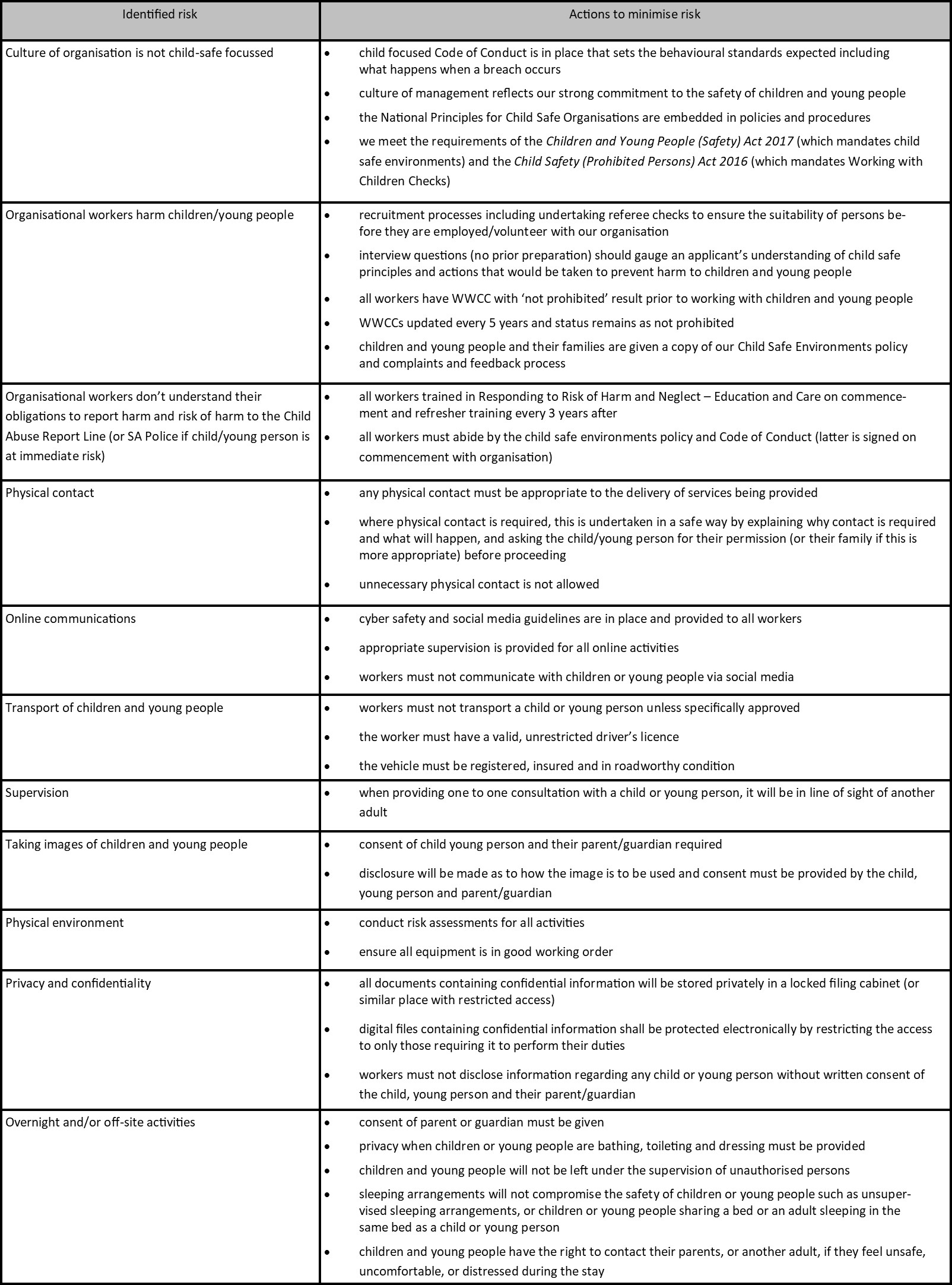
Risk management

The list below describes the specific risks to children and young people at Muirden Senior College and the actions that will be taken to minimise and manage each of the risks.

Policy review

Muirden Senior College will, at a minimum, review this policy and the related procedures once every 5 years as required by the Children and Young People (Safety) Act 2017.  We will also review this policy when:

  • new or added risks are identified for children or young people, which may require a change in the policy or procedures
  • a critical incident where a child or young person has experienced harm through involvement in the organisation
  • concerns are raised by anyone involved in your organisation about child safety or welfare in the organisation
  • awareness or compliance to the child safe policy and/or procedures is low
  • legislative changes/requirements

We will lodge a new child safe environments compliance statement with the Department of Human Services each time we review and update this policy.

Policy Date:                22/01/2024

Review Date:              22/01/2029

Critical Incident

Muirden Senior College promotes an environment of friendliness, genuine concern for students, staff and community safety. We aim to ensure the safety of staff, students, visitors and the wider community in the event of an emergency/critical incident occurring.


Definition


An Emergency/Critical Incident is an unforseen occurrence which requires sudden and urgent action. This may include, but not limited to, events such as:


  • Threatened/actual assault, injury or fatality
  • Vehicle accident
  • Siege/hostage/disappearance or removal of a student
  • Firearm/bomb threat
  • Damage to buildings or equipment
  • Fire in college building/bushfire
  • Fume/spill/leak/contamination by hazardous material/s
  • Earthquake/building collapse/storm damage


Prevention and Preparedness


  • Establish and communicate procedures
  • Have designated OHS&W rep
  • Have access to panic button system
  • Know who is in building – all non-college members are to report to the front office
  • Remain vigilant and inform police in regards to threats to worksite or specific staff/students
  • Maintain close liaison with local Emergency services and community
  • Alert staff to potential medical or emergency situations


Action and Responses During Critical Incidents


Assess danger identify immediate risks and threats to life – aggressor, medical, environmental hazards, fire


Raise the alarm – inform critical incident management team:


  • A teacher/principal
  • First aid officer
  • H & S representative
  • DO NOT CONFRONT AGGRESSOR OR IMMEDIATE RISK refer to Principal or nominated delegate to refer to Critical Incident Management Plan
  • Restrict danger area (if possible) – remove yourself and others from immediate danger


The critical incident management team will convene. When safe to do so, evacuate and remain in designated area, account for and supervise students.


All follow instructions given by principal, and or, the critical incident management team.


Response After Critical Incidents


  • Inform incident to relevant family/carers or organisations.
  • Counselling and/or debriefing for all persons affected.
  • Make people aware or services and support available.
  • Continued monitoring of all persons affected by critical incident.

Electronic Devices

Definition

Muirden Senior College allows students access to its computer network and online facilities such as Internet and email. Muirden Senior College also allow students use of electronic devices such as mobile phones or digital cameras. Students have unrestricted access to the college facilities and other electronic devices on the basis that the use is only for acceptable and ethical purposes.


What students should do


Students using the computer network and other electronic devices will comply with the following acceptable and ethical purposes.


Acceptable Uses


  • Computer network and facilities
  • Use in connection with subject curriculum
  • Carry out school work
  • Research projects or assignments
  • Send and receive email
  • Explore the Internet in connection to school work and along guidelines set out by the subject teacher
  • Use the network storage space for curriculum related files and delete files when no longer needed


Other electronic devices


Arrange with subject teacher for mobile phone to be on during lesson time
use mobile phones in a manner that does not disturb others or as requested by the subject teacher.


Ethical Uses


Ethical purposes means that students are not allowed to breach standards of common decency, or manners, and must not break any laws. Ethical behaviours may include but are not limited to the following:


  • Be polite, courteous and respectful toward anybody else
  • Use appropriate language
  • Comply with the standards of public decency
  • Respect the rights of other computer users
  • Observe the copyright that exists on other people’s work on the computer network and Internet
  • Obey the law
  • Refrain from downloading or uploading any software without approval
  • Be respectful of others when using digital cameras and mobile phones such as only take or use anybody’s photo with their permission
  • Comply with this Policy


What the college will do


If in the College’s opinion a student has used the computer network and other electronic devices:


  • For an unacceptable purpose
  • Unethically; or
  • Otherwise inappropriately including violation of this Policy
  • Any of the following may occur:
    • That student’s privilege of access may be temporarily removed or restricted
    • Any inappropriate files may be deleted without warning
      a meeting with the principal concerning the breach of Policy
    • Students should be aware that breaches of the criminal law using the computer network may be a matter for the police.


Students should also be aware that Muirden Senior College will cooperate with the police, and other authorities, in any investigation relating to the illegal uses of the computer network or other electronic devices.


Network Privacy and Security Issues


Students should be aware that their electronic communication and work created via the college’s network is not private, and that Muirden Senior College may access their work.


This extends to:


  • Files in connection with their curriculum
  • Incoming and outgoing email communications
  • Sites assessed on the Internet


So that Muirden Senior College can comply with its obligations under law, Muirden Senior College reserves the right to screen student’s files and work to ensure that the computer network is being used for acceptable purposes and in accordance with this Policy.


In addition, student’s files may be assessed by Muirden Senior College’s system administrators as part of normal maintenance procedures. “Normal maintenance” includes spot checks to ensure that inappropriate materials, or words subject to another person’s copyright, are not being kept in private folders and inappropriate Internet sites have not been visited.


Safety


Students should not do anything via Muirden Senior College’s computer network which may possibly jeopardise their personal safety either at college or outside college.


In particular, students:


  • MUST NOT give out any identifying details such as their home address or telephone number, college name in a public chat or bulletin board.
  • Students should only disclose those details to people personally known to them, and those they trust.
  • MUST NOT give out personal information such as age, gender, marital status or financial position.
  • MUST NOT arrange a meeting in person with another person they have “met” on only communicated with by computer, without prior parental approval. If a meeting is arranged, it should be in a public place in the presence of a parent or responsible adult.
  • MUST NOT respond to messages or bulletin board items that are indecent, suggestive, belligerent, discriminatory, threatening, or which make the student feel uncomfortable or unsafe in any way.


In addition, students;


  • MUST tell the principal, the system administrator or their parents if an indecent, suggestive, belligerent or threatening message is encountered.
  • The principal will then make a copy of that message and refer it to the appropriate authorities, including the police if necessary.
  • SHOULD be aware that people they “meet” or communicate with online may pretend to be someone else.
  • SHOULD remember that everything they read online may not be accurate.
  • SHOULD avoid offers which involve either financial transactions or personal meetings.


Limitations of Liability


Students will be allowed access to the computer network as part of curriculum work. It is not practical that every student will be supervised individually when using the computer network and Muirden Senior College expects students to act responsibly and sensibly when using the computer network.


Muirden Senior College does not accept any liability which may result from any student’s unacceptable or unethical uses of the computer network.

Excursions

Excursions are a valuable part of the learning experience. Teachers are encouraged to make use of these, especially where these can be undertaken within the city precincts.


Definition


For the purposes of this policy an excursion is defined as any activity undertaken outside of college premises for a specific educational purpose.


Excursions undertaken within ordinary lessons – on foot and in the local area.


  • Students do not need parental approval to leave the college.
  • A teacher will be present with the students during the formal part of the excursion, but may arrange to meet students at the site. They may also be dismissed from the site.


Excursions undertaken within ordinary lessons – transport other than by foot.


  • Excursions requiring travelling a distance from the college for a part or full day trip may require the permission of a parent/guardian, if the student is under 18 years of age.
  • A teacher will be present with the students during the formal part of the excursion, but may arrange to meet students at the site. They may also be dismissed from the site.
  • Students must have signed permission from their parent/guardian if travelling in another student’s vehicle.


Excursions requiring students to miss other classes.


  • Parents/caregivers must be informed and approval may be required if other lessons are missed as a result of the excursion.
  • Staff members whose lessons will be affected by the absence of students on an excursion must be informed.


Excursions out of college hours.


If the student is under 18 years of age, parents/caregivers must be informed and approval may be required if an excursion will be undertaken during out of college hours.


Excursions necessitating overnight accommodation


If the student is under 18 years of age, parents/caregivers must be informed and approval will be required if an excursion is held over a period where overnight accommodation is needed.


Medical forms must be completed and returned to the office before a student is given final approval by the Principal to attend the excursion.


Note


  • All excursions must be recorded at the front office.
  • There is to be a minimum requirement of 2 students for an excursion to take place unless approval has been granted under special circumstances.
  • There may be some costs involved to the student.
  • Staff are encouraged not to transport students to or from sites unless in special circumstances.

Grievance Policy

The Grievance Policy procedures included here are designed to provide students, parents, and caregivers with an opportunity to raise matters of concern about their interaction with the students and staff.

Muirden Senior College is committed to working collaboratively with families to resolve issues respectfully, fairly, and promptly.


Related definitions

Grievances are characterised by conflict and/or a breakdown of communication and respect between two or more persons resulting in unhappiness, friction, or stress.


Principles

The following principles apply to our complaints handling:

  • Students, parents, and caregivers have the right to raise any complaints or grievances without fear of retribution
  • All complaints will be given due consideration with the primary objective of the complaints process being to find an immediate solution which is agreed by all parties
  • No student will be disadvantaged as a result of a complaint made in good faith
  • Complaints handling and resolution processes are student focused and are designed to prevent similar complaints from reoccurring
  • The views of both the complainant and the respondent are respected and are free from discrimination and victimisation
  • Written records are kept of all complaints
  • Where appropriate we respect the right of the complainant to seek the assistance of an external organisation to resolve the complaint
  • Neither the Minister for Education, Training and Skills nor the Department for Education has any power to directly intervene in any complaints relating to the operations of a non-government school


Scope
This policy applies to concerns or complaints raised by students, parents, and caregivers about:

  • School policies and procedures
  • Teaching and learning
  • Staff conduct or communication
  • Student wellbeing or behaviour management
  • School environment or safety


Unacceptable Conduct

We understand that complaints may be made in challenging circumstances, but aggressive, abusive, or threatening behaviour towards staff will not be tolerated. In such cases, the College may take steps to limit communication and protect staff wellbeing.


Process for student grievances

The following steps state the process involved should a student have a grievance with another student, a teacher, or the principal.


For a grievance between students

Step 1: Try to reach a resolution with the other party using discussion

Step 2: If a satisfactory resolution cannot be achieved, report the grievance to a teacher who will:

  • Record the grievance if verbal
  • Listen to both parties without judgement
  • Mediate to reach a mutually satisfactory solution

If the teacher is unable to reach a satisfactory outcome:

Step 3: Report the grievance to the principal who will:

  • Listen to both parties without judgement
  • Commit to find a resolution


For a grievance with a teacher

Step 1: Try to reach a resolution with the teacher concerned using discussion

Step 2: If a satisfactory resolution cannot be achieved, report the grievance to the principal, not another teacher, who will:

  • Record the grievance if verbal
  • Arrange a meeting with the student and staff member
  • Listen to both parties without judgement
  • Mediate to reach a mutually satisfactory solution


For a grievance with the principal

Step 1: Try to reach a resolution with the principal using discussion

Step 2: If a satisfactory resolution cannot be achieved, report the grievance to a member of the Board of Directors who will:

  • Record the grievance if verbal
  • Arrange a meeting with the student and principal
  • Listen to both parties without judgement
  • Mediate to reach a mutually satisfactory solution


Process for parent and caregiver grievances

The following steps state the process involved should a parent or caregiver have a grievance with a student, a teacher, or the principal.

For a grievance with a student (other than their own)

Step 1: Report the grievance to the principal who will:

  • Listen to both parties without judgement
  • Commit to find a resolution


For a grievance with a teacher

Step 1: Report the grievance to the principal who will:

  • Record the grievance if verbal
  • Listen to both parties without judgement
  • Mediate to reach a mutually satisfactory solution


For a grievance with the principal

Step 1: Try to reach a resolution with the principal using discussion

Step 2: If a satisfactory resolution cannot be achieved, report the grievance to a member of the Board of Directors who will:

  • Record the grievance if verbal
  • Listen to both parties without judgement
  • Mediate to reach a mutually satisfactory solution

Privacy Policy

This Privacy Policy sets out how the School manages personal information and your rights in relation to your personal information, including how to complain and how we deal with complaints.

The School is bound by the Australian Privacy Principles contained in the Commonwealth Privacy Act 1988 (Privacy Act).

Under the Privacy Act the Australian Privacy Principles do not apply to certain treatment of an employee record. As a result, this Privacy Policy does not apply to the School’s treatment of an employee record held by the School, where the treatment is directly related to a current or former employment relationship between the School and the employee.

The School may, from time to time, review and update this Privacy Policy to take account of new laws and technology, changes to the School’s operations and practices and to make sure it remains appropriate to the changing school environment.


Kinds of personal information we collect

The types of information the School collects includes (but is not limited to) personal information, including health and other sensitive information, about:

  • students and parents and/or guardians (‘Parents’) before, during and after the course of a student’s enrolment at the School, including:
    • name, contact details (including next of kin), date of birth, gender, language background, previous school and religion;
    • parents’ education, occupation, language spoken at home, nationality and country of birth;
    • health information (e.g., details of disability and/or allergies, dietary requirements, absence notes, immunisation details, medical reports and names of doctors);
    • results of assignments, tests and examinations;
    • conduct and complaint records, or other behaviour notes, and school reports;
    • information about referrals to government welfare agencies;
    • counselling reports;
    • health fund details and Medicare number;
    • any Family Court orders;
    • criminal records;
    • volunteering information; and
    • photos and videos at School events;
  • job applicants, volunteers and contractors, including:
    • name, contact details (including next of kin), date of birth
    • information on job application;
    • professional development history;
    • salary and payment information, including superannuation details;
    • health information (e.g., details of disability and/or allergies, and medical certificates);
    • complaint records and investigation reports;
    • leave details;
    • photos and videos at School events;
    • workplace surveillance information; and
    • work emails and private emails (when using work email address) and Internet browsing history; and
  • other people who come into contact with the School, including name and contact details and any other information necessary for the particular contact with the School.


How we collect personal information

Personal information you provide: The School generally collects personal information about an individual directly from the individual (or their Parent in the case of students). This includes by way of forms, face-to-face meetings and interviews, emails and telephone calls.

Personal information provided by other people: In some circumstances the School may be provided with personal information about an individual from a third party, for example a report provided by a medical professional, a reference from another school or a referee for a job applicant. If a student transfers to a new school, the new school may collect personal information about the student from the student’s previous school to facilitate the transfer of the student.

Personal information from other sources: We may also collect personal information through surveillance activities (such as CCTV security cameras) and [student email monitoring].


Purposes for which we collect, use and disclose personal information

The purposes for which the School collects, uses and discloses personal information depend on our relationship with you and include the following:

Students and Parents:

  • providing schooling and school activities;
  • satisfying the needs of Parents, the needs of students and the needs of the School throughout the whole period a student is enrolled at the School;
  • making required reports to government authorities;
  • keeping Parents informed about matters related to their child’s schooling, through correspondence, apps, newsletters and magazines;
  • day-to-day administration of the School;
  • looking after students’ educational, social and health wellbeing;
  • seeking donations for the School (see the ‘Fundraising’ section of this Privacy Policy); and
  • to satisfy the School’s legal obligations and allow the School to discharge its duty of care.

Volunteers:

  • to contact you about, and administer, the volunteer position;
  • for insurance purposes; and
  • satisfying the School’s legal obligations, for example, in relation to child protection legislation.

Job applicants and contractors:

  • assessing and (if successful) engaging the applicant or contractor;
  • administering the individual’s employment or contract;
  • seeking donations for the School (see the ‘Fundraising’ section of this Privacy Policy);
  • for insurance purposes; and
  • satisfying the School’s legal obligations, for example, in relation to child protection legislation.


Who we disclose personal information to

The School may disclose personal information, including sensitive information, for educational, care and administrative purposes, and to seek support and advice. This may include to:

  • other schools and teachers at those schools, including a new school to which a student transfers to facilitate the transfer of the student;
  • government departments (including for policy and funding purposes);
  • medical practitioners;
  • people providing educational, support and health services to the School, including specialist visiting teachers, [sports] coaches, volunteers, and counsellors;
  • organisations that assist us with fundraising (see the ‘Fundraising’ section of this Privacy Policy);
  • providers of learning and assessment tools;
  • providers of specialist advisory services and assistance to the School, including in the area of Human Resources, child protection, students with additional needs and for the purpose of administering Google Apps for Education and ensuring its proper use (see further the section below ‘Sending and storing information overseas);
  • assessment and educational authorities, including the Australian Curriculum, Assessment and Reporting Authority (ACARA)
  • agencies and organisations to whom we are required to disclose personal information for education, funding and research purposes;
  • people providing administrative and financial services to the School;
  • the provider of our information management and storage system and other information technology services;
  • recipients of School publications, such as newsletters and magazines;
  • students’ parents or guardians;
  • anyone you authorise the School to disclose information to; and
  • anyone to whom we are required or authorised to disclose the information to by law, including child protection laws.


How we store personal information

We store your personal information in hard copy and electronically. We use information management and storage systems provided by third party service providers. Personal information is stored with and accessible by the third party service providers for the purpose of providing services to the School in connection with the systems. The School may use online or ‘cloud’ service providers to store personal information and to provide services to the School that involve the use of personal information. See further the section below ‘Sending and storing information overseas.’


Sending and storing information overseas

The School may use online or ‘cloud’ service providers to store personal information and to provide services to the School that involve the use of personal information, such as services relating to email, instant messaging and education and assessment applications. Some limited personal information may also be provided to these service providers to enable them to authenticate users that access their services and provide technical support. This personal information may be stored in the ‘cloud’ which means that it may reside on a cloud service provider’s servers which may be situated outside Australia.

An example of such a cloud service provider is Google. Google provides the ‘Google Apps for Education’ (GAFE) including Gmail, and stores and processes limited personal information for this purpose. School personnel and the AIS and its service providers may have the ability to access, monitor, use or disclose emails, communications (e.g., instant messaging), documents and associated administrative data for the purposes of administering GAFE and ensuring its proper use.


Fundraising and marketing

The School treats seeking donations for the future growth and development of the School as an important part of ensuring that the School continues to provide a quality learning environment in which both students and staff thrive. Your personal information may be used to make an appeal to you. It may also be disclosed to organisations that assist in the School’s fundraising activities, for example, the School’s Foundation or alumni organisation and, on occasions, external fundraising organisations. If you do not want to receive fundraising communications from us, please contact our front office.


Security of personal information

The School has in place steps to protect the personal information the School holds from misuse, interference and loss, unauthorised access, modification or disclosure by use of various methods including locked storage of paper records and password access rights to computerised records. These steps include:

  • Restricting access to information on the School databases on a need to know basis with different levels of security being allocated to staff based on their roles and responsibilities and security profile.
  • Ensuring all staff are aware that they are not to reveal or share personal passwords.
  • Ensuring where personal and health information is stored in hard copy files that these files are stored in lockable filing cabinets in lockable rooms. Access to these records is restricted to staff on a need to know basis.
  • Implementing physical security measures around the School buildings and grounds to prevent break-ins.
  • Implementing ICT security systems, policies and procedures, designed to protect personal information storage on our computer networks.
  • Implementing human recourses policies and procedures, such as email and internet usage, confidentiality and document security policies, designed to ensure that staff follow correct protocols when handling personal information.
  • Undertaking due diligence with respect to third party service providers who may have access to personal information, including cloud service providers, to ensure as far as practicable that they are compliant with the Australian Privacy Principles or a similar privacy regime.


Access and correction of personal information

Under the Commonwealth Privacy Act, an individual has the right to seek access to, and/or correction of, any personal information which the School holds about them. Students will generally be able to access and update their personal information through their Parents, but older students may seek access and correction themselves. There are some exceptions to these rights set out in the applicable legislation.

To make a request to access, update or correct any personal information the School holds about you or your child, please contact the School Administrator or School Principal by telephone (08) 8212 4342 or email muirden@muirden.sa.edu.au. The School may require you to verify your identity and specify what information you require. The School may charge a reasonable fee for giving access to your personal information (but will not charge for the making of the request or to correct your personal information). If the information sought is extensive, the School will advise the likely cost in advance. If we decide to refuse your request, we will provide you with written notice explaining the reasons for refusal (unless, in light of the grounds for refusing, it would be unreasonable to provide reasons) and how to complain.


Consent and rights of access to the personal information of students

The School respects every Parent’s right to make decisions concerning their child’s education.

Generally, the School will refer any requests for consent and notices in relation to the personal information of a student to the student’s Parents. Generally, the School will treat consent given by Parents as consent given on behalf of the student, and notice to Parents will act as notice given to the student.

Parents may seek access to personal information held by the School about them or their child by contacting the School Administrator or School Principal by telephone (08) 8212 4342 or email muirden@muirden.sa.edu.au. However, there may be occasions when access is denied. Such occasions may include (but are not limited to) where the School believes the student has capacity to consent and the School is not permitted to disclose the information to the Parent without the student’s consent, where release of the information would have an unreasonable impact on the privacy of others, or where the release may result in a breach of the School’s duty of care to the student. The School may, at its discretion, on the request of a student grant that student access to information held by the School about them, or allow a student to give or withhold consent to the use of their personal information, independently of their Parents. This would normally be done only when the maturity of the student and/or the student’s personal circumstances warrant it.


Enquiries and complaints

If you would like further information about the way the School manages the personal information it holds, or wish to complain that you believe that the School has breached the Australian Privacy Principles [or the Health Privacy Principles] please contact the School Principal by telephone (08) 8212 4342 or email muirden@muirden.sa.edu.au or by post, 368 King William Street, Adelaide S.A. 5000. The School will investigate any complaint and will notify you of the making of a decision in relation to your complaint as soon as is practicable after it has been made. If you are not satisfied with our response, you may complain to the Office of the Australian Information Commissioner (OAIC) via the OAIC website, www.oaic.gov.au.

Submission of Work Policy

STAGE 1

Submission of Drafts

  • If a student does not submit a draft by the due date, the teacher will not accept a draft and the final (undrafted) submission will be assessed
  • Drafts must be returned within 7 days to students
  • Students need adequate time to complete their final assignment. To achieve this all students must be provided a minimum of 7 days to complete a final submission of work once a draft has been returned to the student


Non-submission of work

  • If a student fails to submit a final assignment by the provided due date, then an email is sent to the student asap advising they have missed the due date and the impacts that a non-submission will have on their grade. These communications are also sent to parents/guardians, Heath, and Anj.


Extensions

  • Assignment extensions are at the discretion of the teacher and in collaboration with a student ILP if applicable. However, students are not to be given any more than one extension. If they fail to meet this extension due date the non-submission of work process must be followed. If an extended due date is missed, an email is sent to the student with parents/caregivers, Heath and Anj CC’d in advising they have received a zero (N).


Submission of Final Work

  • All assessments must be submitted via Moodle by midnight on the day the assessment is due. If a student needs to negotiate a due date, they must communicate with the teacher either in person or via email one day before the assessment deadline. They need to clearly articulate why they are not able to meet the due date and develop a clear plan to submit the task by the newly negotiated deadline. Students that do not submit an assessment by the due date (without negotiating with the teacher) will be graded as a zero (N) for that task.


STAGE 2


Submission of Drafts

  • If a student does not submit a draft by the due date, the teacher will not accept a draft and the final (undrafted) submission will be assessed
  • Drafts must be returned within 7 days to students
  • Students need adequate time to complete their final assignment. To achieve this all students must be provided a minimum of 7 days to complete a final submission of work once a draft has been returned to the student


Non-submission of work

  • If a student fails to submit a final assignment by the provided due date, then an email is sent to the student asap advising they have missed the due date, and the impacts that a non-submission will have on their grade. These communications are also sent to parents/guardians, Heath, and Anj.


Extensions

  • Assignment extensions are at the discretion of the teacher and in collaboration with a student ILP if applicable. However, students are not to be given any more than one extension. If they fail to meet this extension due date the non-submission of work process must be followed. If an extended due date is missed, an email is sent to the student with parents/caregivers, Heath and Anj CC’d in advising they have received a zero (N).
  • In circumstances where a Stage 2 student can still submit the outstanding piece of work before the end of the year, students must have all other summative assessments completed before submitting the outstanding work. This will ensure that students do not focus on overdue work and fall behind with the next assignment.


Submission of Final Work

  • All assessments must be submitted via Moodle by midnight on the day the assessment is due. If a student needs to negotiate a due date, they must communicate with the teacher either in person or via email one day before the assessment deadline. They need to clearly articulate why they are not able to meet the due date and develop a clear plan to submit the task by the newly negotiated deadline. Students that do not submit an assessment by the due date (without negotiating with the teacher) will be graded as a zero (N) for that task.

Student Driving Policy

NO ONSITE PARKING

There is no onsite parking available for students at Muirden Senior College. Students who have their driver’s licence can park their vehicles in the nearby designated street parking areas, including 4 hour parking spaces or high rise parking complexes.


DRIVING A MOTOR VEHICLE

A student who drives a motor vehicle unsupervised, must have the appropriate and legal driver’s licence as required by the Motor Vehicles Act 1959.

A student must not drive a vehicle or attempt to put a vehicle in motion while under the influence of intoxicating liquor, or prohibited drugs as specified in the Road Traffic Act 1961.


ARRIVAL AND DEPARTURE EXPECTATIONS

Students are expected to arrive at school on time, with parking secured before their class begins. Driving should not be a cause for tardiness, and students must ensure they leave home early enough to park nearby and walk to school on time. The use of nearby 2 hour parking spaces is not permitted as this timeframe is not long enough for students to attend the entire duration of their 2 hour lessons.

Students may retrieve their vehicles from their parking space only after their last class of the day or during free periods. Breaks between classes may not be enough time to find a new parking space.


VEHICLE MOVEMENT DURING SCHOOL HOURS

Students are not permitted to leave school grounds during lessons to move or check on their vehicles. The only exceptions to this rule are emergency situations. In the case of an emergency, students must seek permission from the College Front Office before leaving to attend to their vehicle.


PUNCTUALITY AND RESPONSIBILITY

Students must manage their time effectively to ensure that driving and parking do not interfere with their school schedule. Arriving late due to difficulty finding parking is not an acceptable excuse.

Students are expected to follow all road rules and practice safe driving at all times. They must also respect the local community and avoid parking in restricted or residential areas.


CONSEQUENCES FOR POLICY VIOLATIONS

Breaching this policy will result in a warning and reminder of the policy, followed by notification to parents and caregivers.

For any questions or concerns regarding this policy, please contact the College directly.